Engine Monitoring
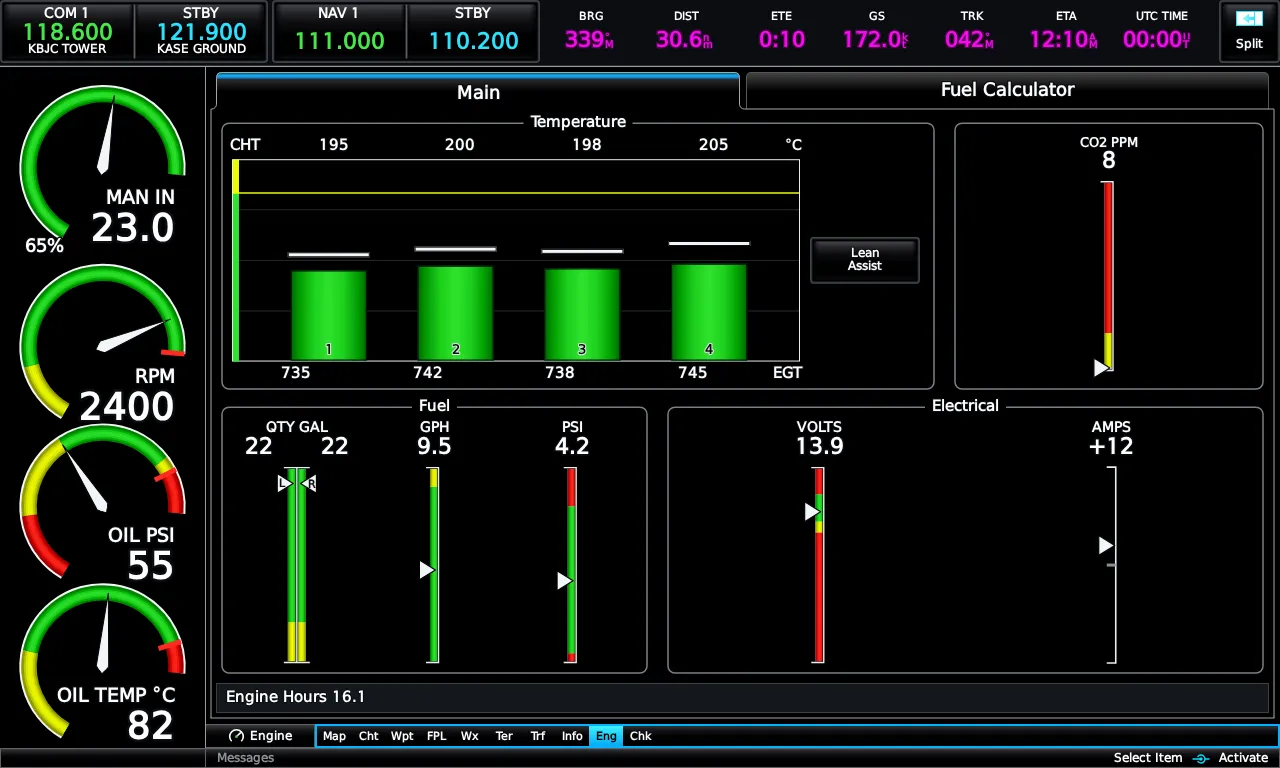
The EIS strip and the Engine page
Section titled “The EIS strip and the Engine page”The EIS (engine indication system) strip rides along the edge of the display whenever engine data is set up. The full Engine page has two tabs: Main, laid out as the real unit’s grid of temperature, fuel, and electrical groups, and Fuel Calculator. A twin adds an Electrical tab. Setup → Display sets where the strip lives: PFD or MFD, left or right, and narrow or wide. It also sets whether the strip combines with the engine page or stays separate.
Airframe profiles
Section titled “Airframe profiles”Gauges are data-driven per aircraft: which gauges exist, their ranges, zones, and redlines. Built-in profiles cover the Cessna 172S Skyhawk, PA-28-181 Archer III, PA-28R Arrow (JustFlight), Cirrus SR22, and Van’s RV-10. They also cover the Beechcraft Baron 58, Beechcraft King Air C90B, Lancair Evolution, Cirrus SF50 Vision Jet, Cessna Citation X, and Sikorsky S-76C. So the Skyhawk gets four cylinders and no manifold pressure, and the SR22 gets six and MP.
The gauge set follows the powerplant: piston (RPM, MP, EGT, CHT), turboprop (torque, ITT, Ng, Np), or jet (N1, ITT, N2). The S-76’s turboshafts use turboprop gauges. Twins get dual-needle gauges and side-by-side EGT/CHT.
The E3X chooses the profile automatically from the aircraft your sim reports. An unrecognized aircraft gets a generic panel for its engine type and count, rather than a mismatched one. That panel takes its ranges and redlines from the sim’s own aircraft limits. You can override any gauge’s limits per aircraft on the Engine tab of Setup → Config.
CAS messages
Section titled “CAS messages”Exceedances raise warning / caution / advisory messages on the CAS (crew alerting system) stack. Warning text flashes until you acknowledge it: touch the message (or press BACK). A message clears when its condition does, and re-annunciates if it comes back. Touching the CAS window opens the full message list.
Lean assist
Section titled “Lean assist”Touch Lean Assist on the engine page’s temperature group and lean normally. The E3X tracks each cylinder’s EGT peak and marks the first and last cylinders to peak. It also reads out degrees rich or lean of peak per cylinder. Where the sim reports true per-cylinder probes, the E3X uses those unchanged. Where it reports only a single EGT, the E3X creates a realistic per-cylinder spread so the leaning procedure still teaches correctly.
Fuel calculator
Section titled “Fuel calculator”On the Fuel Calculator tab, + and − add or subtract fuel, and touching the remaining figure sets it outright. The tab also has one-tap Tabs and Full presets for your airframe. Entries cannot exceed tank capacity. The totalizer, the E3X’s running fuel count, burns down from there. It feeds the map’s fuel-range ring and the flight plan’s Fuel Remaining At Waypoint column, so range answers stay honest all flight.
Emrelia E3X is an independent product of Emrelia LLC. It is not affiliated with, endorsed by, or sponsored by Garmin Ltd. or its affiliates. G3X Touch™ is a trademark of Garmin Ltd. For flight simulation use only — not for use in real-world navigation. Map imagery contains data © OpenStreetMap contributors (ODbL) and other sources — see data attributions. © 2026 Emrelia LLC.